
Chi Nei Tsang: Unwinding the Belly, balancing all of your inner elements

Abdominal bodywork, the gut–brain connection and the art of listening within.
There are moments when the belly speaks before we have words.
The flutter before something important. The tightening during a difficult conversation. The way we draw the abdomen inward when we feel exposed, or realise we have been holding our breath all day.
At Sundari Rituals, the belly is a place we approach with curiosity and respect. It is central to digestion, intimately involved in breathing, and often where we first notice the physical experience of stress.
Chi Nei Tsang invites us to slow down and meet this area through attentive touch, breath and awareness. For some, it offers an unfamiliar experience: allowing the belly to be supported without asking it to stay held, flat or controlled.
What is Chi Nei Tsang?
Chi Nei Tsang, often abbreviated to CNT, is a form of abdominal bodywork associated with Taoist healing practices. Its name is commonly translated as “working with the energy of the internal organs.”
Contemporary CNT has been developed and shared internationally through the teachings of Mantak Chia and the Universal Healing Tao system. Its traditional framework brings together abdominal touch, breath, awareness and practices for cultivating qi, or life energy. It detoxifies, and balances the body’s five elements (fire, water, air, earth, ether), thereby also balancing the person’s psyche.
Within this tradition, the abdomen is understood as a centre of vitality. The lower dantian, below the navel, is an important focus in qigong and internal cultivation.
From an anatomical perspective, the abdomen contains organs, connective tissues, blood vessels and extensive nerve networks. Hands contact the abdominal wall and transmit pressure through the tissues; they do not directly touch an exposed organ. Sensitivity, anatomical knowledge and appropriate pressure matter.
The belly and the gut–brain conversation
The digestive tract contains its own extensive nerve network: the enteric nervous system. Often called the “second brain,” it helps coordinate digestive activity. The phrase does not mean the gut thinks in the same way as the brain or stores autobiographical memories inside individual organs.
The gut and brain communicate in both directions through neural pathways, alongside hormonal and immune signalling. This helps explain why emotional experiences can have digestive effectsand why digestive discomfort can influence how we feel.
IBS is recognised as a disorder of gut–brain interaction. Changes in this communication can affect bowel movement and sensitivity to sensations within the gut. Symptoms are real, and their causes can be complex.
A person may notice that their belly tightens during stress, but this does not establish stress as the sole cause of their symptoms. Listening to the body and seeking appropriate medical assessment can belong to the same approach to care.
What does “unwinding the belly” mean?
Unwinding describes an experience rather than a promise to reposition organs.
It may involve noticing habitual abdominal bracing, finding a more comfortable breath, or allowing touch without automatically tightening against it. Sometimes the change is subtle: a less guarded feeling, a quieter moment, or greater awareness of where tension begins.
The diaphragm, abdominal wall and pelvic floor participate in the changing pressures of breathing. Comfortable breathing and attentive touch offer a way to explore this relationship without forcing expansion or trying to make the body release.
For students and practitioners, the distinction is essential: a softer abdomen after touch does not prove that an adhesion has been removed, an organ corrected or a trauma resolved.
When might abdominal bodywork help?
Stress-related abdominal tension
If you habitually hold your belly, tighten around the ribs or notice digestive discomfort during stressful periods, a carefully paced session may offer space to explore those patterns.
The intention is to support comfort and awareness. Feeling calmer after a session is meaningful, but it does not establish a measurable “vagus nerve reset” or guarantee lasting nervous system change.
Reconnection with bodily sensation
Some people feel disconnected from the belly. Others monitor it constantly or feel uneasy when it is touched.
The practice can begin with recognising what feels comfortable, what feels too much, and whether abdominal touch is wanted at all. A useful outcome may be greater confidence in expressing a boundary or noticing tension earlier.
CNT should not be presented as a proven treatment for infertility, autoimmune disease, chronic fatigue, psychological disorders or unexplained pain. These concerns require appropriate assessment and care.
Emotions, organs and the five phases
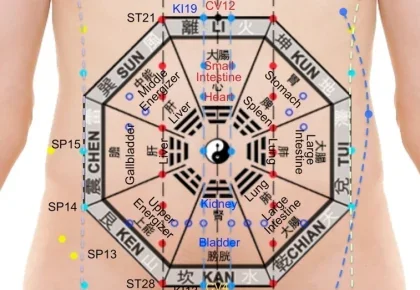
Taoist and Chinese medicine traditions describe relationships between organ systems, emotional qualities and the five phases: Wood, Fire, Earth, Metal and Water.
These are traditional ways of interpreting patterns and relationships. They are distinct from the Ayurvedic elements of earth, water, fire, air and ether, and they should not be treated as interchangeable.
Within the Chinese framework, anger is often associated with the Liver system, fear with the Kidney system, and grief with the Lung system. These systems have meanings beyond the corresponding anatomical organs.
Such associations can provide a reflective language for experience. They do not allow a practitioner to diagnose an emotion by pressing on the abdomen, or to conclude that anger caused someone’s liver disease.
At Sundari Rituals, emotional awareness is approached without blame. Illness is never evidence that someone has failed to process their feelings.
Can emotions arise during a session?
They can. A person may feel tenderness, sadness, relief, laughter or a wish to be quiet. Others experience no particular emotion.
We sometimes describe stress or trauma as being “held in the body.” A grounded way to understand this is that difficult experiences can influence muscle tension, breathing, sensitivity, attention and protective responses. This differs from claiming that a specific memory is physically trapped in an organ.
There is no need to cry, remember an event or produce an intense release for a session to be worthwhile. Emotional intensity is not a measure of healing.
If something feels overwhelming, the work can pause. You may open your eyes, change position, ask for lighter contact or stop entirely. Choice remains part of the practice throughout.
Breath and the Taoist healing sounds
Some CNT traditions incorporate the Six Healing Sounds, using particular exhaled sounds, postures and attention directed towards traditional organ systems.
They are practices within a Taoist framework, rather than scientifically established sound frequencies that detoxify individual organs.
In a session, a soft sound or comfortable exhale may help someone focus attention and notice their breathing. Participation is optional. Breath should remain easy; there is no need to push, hold or exaggerate it.
What happens during a session?
A session begins with a conversation about your symptoms, health history, surgery, medications and what you hope to receive. Your comfort with abdominal touch is part of that discussion.
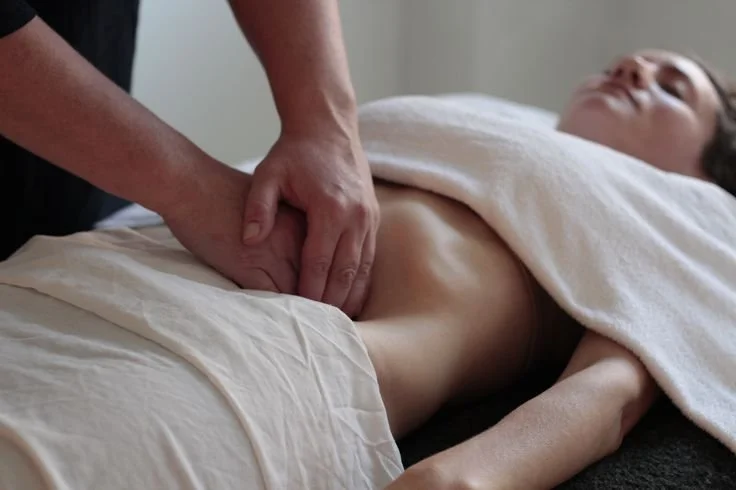
Typically, you lie on your back with support where needed. The abdomen is uncovered only with permission, and the rest of the body remains appropriately draped.
Depending on the approach, a practitioner may use broad palm contact, fingertips, gentle circular movements and a small amount of oil. Pressure is adjusted in response to comfort and health considerations.
More pressure does not mean more benefit. Pain, breath-holding or a strong urge to brace are reasons to reassess the contact.
The session closes with time to settle and discuss simple ways to support yourself at home. Length and frequency should reflect individual needs; there is no universal requirement for ten sessions or a fixed twice-weekly schedule.
A clearer understanding of “detox”
Traditional CNT descriptions often use words such as stagnation, cleansing and detoxification. These belong to its traditional language.
In biomedical terms, a massage has not been shown to extract toxins from organs. Likewise, improvements in comfort or bowel habits do not prove that immunity has been strengthened or disease resistance increased.
We can value rest, easier movement and a more comfortable belly without attaching unsupported claims to those experiences.
When abdominal massage needs to wait
Abdominal bodywork requires screening. Pregnancy, recent abdominal surgery, suspected bowel obstruction, abdominal growths and inflammatory bowel conditions are among the situations in which abdominal massage may be unsuitable. A hernia also requires particular care.
Tell your practitioner about relevant diagnoses, heart or blood pressure conditions, clotting concerns, blood-thinning medication and any implanted devices.
Menstruation and an IUD should be discussed in context rather than treated as identical, automatic exclusions for every form of abdominal touch. New pelvic pain, unusual bleeding or concerns about an IUD need clinical assessment.
There is also no single waiting period after surgery that makes every technique safe. Suitability depends on the procedure, healing and advice from the treating clinician.
New or severe abdominal pain, fever, persistent vomiting, blood in the stool, unexplained weight loss, or a swollen abdomen with inability to pass stool or gas calls for medical assessment rather than massage.
A gentle first practice: simply notice
You do not need to begin by pressing into your belly.
Sit or lie comfortably. If it feels welcome, rest one hand lightly over your clothing.
Let your breathing stay natural. Notice whether your hand moves, whether the belly feels held, and whether contact feels comforting, neutral or unwelcome. There is nothing you need to change.
If comfortable, allow an easy breath in and a soft breath out through the mouth, as though gently blowing towards a candle in the distance. Avoid forcing a long exhale.
Stay for a few breaths, then remove your hand. Stop if you notice pain, dizziness, nausea or distress. This is an awareness practice, rather than instruction in deep self-massage.
For future students: the skill is in how we listen
Learning abdominal bodywork involves anatomy, clinical reasoning, consent and the ability to recognise when referral is needed.
An abdomen can feel tender or tense for many reasons. Palpation alone cannot establish the cause, reveal someone’s emotional history or confirm disease.
A thoughtful practitioner asks, “How does this contact feel?” They allow the client’s experience to guide the conversation without assigning a story to it.
Depth in this work comes through sensitivity and discernment: knowing where to place the hands, how to adapt, when to pause, and when another form of care is needed.
An invitation from Sundari Rituals
You do not have to arrive with a story about what your belly is holding.
You can begin with curiosity wish to feel more comfortable, understand your patterns, or experience a gentler relationship with this part of your body.
At Sundari Rituals, this is the spirit of the work: attentive touch, informed care and space to listen.
Explore abdominal bodywork with Sundari Rituals.
Sources and further reading
Doğan et al., 2022: Abdominal massage in functional chronic constipation
Cambridge University Hospitals: Improving bowel function in constipation
